The Rally Maya México 12 route: five stages, one competition
Five stages, one competition
RMM 12 is getting ready to set out on a journey that blends discipline, history and classic motoring. The 2026 edition will bring competitors together on a five-stage route designed to test regularity, consistency and the ability to handle the many different roads of southeast Mexico. Every kilometer will be a threshold to cross, every city a stage where the competition takes on a new nuance.
This rally is best described in the plural. It is, all at once, a museum on wheels, a cultural showcase and a motoring challenge. The RMM 12 route is laid out so that participants take on demanding terrain: from the Chiapas highlands to the Mexican Caribbean, by way of rainforest, coastal highways, farmland and city circuits. The goal is not simply to reach the finish line, but to master every stage with the precision that regularity demands.
Stage 1: Palenque → Calakmul (358 km)
The opening test of endurance.
RMM 12 gets underway with the energy of the opening ceremonies in Palenque. Registration, the welcome dinner and a visit to the archaeological site set the mood. But the real call comes when engines fire up for the run to Calakmul.
The first stage stretches across 358 kilometers, making it the longest of this edition. Palenque, nestled in the northern highlands of Chiapas, is a demanding, high-caliber starting point. From there, competitors climb from Palenque's 60 meters above sea level to Calakmul's 327, as the scenery shifts from hill country to the lowlands of southeastern Campeche, in the Petén region.
The challenge here is twofold: managing the crew's energy over a long run and holding regularity on roads that keep changing. On arrival in Calakmul, the archaeological and natural setting serves as a reminder that the competition is not measured only in kilometers covered, but in the ability to keep a steady nerve from the very start.
The day closes with the Paella Festival and the stage awards, a welcome breather before the next challenge.
Stage 2: Calakmul → Campeche (279 km)
From the rainforest to the Gulf.
The second stage links the rainforest with the coast. Over 279 kilometers, competitors travel one of the busiest corridors on the peninsula: the Villahermosa to Chetumal highway and the Ciudad del Carmen to Campeche route. Both are heavily traveled federal arteries, where drivers face constant traffic and conditions that call for full attention.
If the first stage was about endurance, this one is about skill. Regularity gets harder when you share the road with unpredictable traffic. The sea appears on the horizon as a companion: the Gulf of Mexico runs alongside part of the route, adding a sense of open space but also the need to stay focused.
The destination, San Francisco de Campeche, welcomes the crews with its historic character and strategic location. Here the competition is balanced with culture and cuisine, but the main point is clear: mastering the transition from jungle to coastline is a key step in staying in the running.
Stage 3: Campeche → Chichén Itzá (349 km)
Consistency in Yucatán's farming heartland.
The third stage takes competitors deep into the agricultural landscape of Yucatán. It covers 349 kilometers through the Ring of Cenotes and the Puuc region, on rural highways and narrow back roads.
This leg becomes a test of consistency. Regularity here does not depend on wide highways or free-flowing roads, but on the crews' ability to adapt to a varied mix of local traffic: farm vehicles, small towns along the way, unexpected crossings. It is the second-longest stage and, for that reason, one of the most demanding.
Reaching Chichén Itzá is not just an arrival; it is a symbol. The world-renowned archaeological site becomes the backdrop for the awards for stages 2 and 3. The Nights of Kukulkán show adds drama to the day, a reminder that the competition lives side by side with cultural heritage. Here the crews learn that mastering the road takes not only technical skill but also discipline in the face of the unexpected.
Stage 4: Chichén Itzá → Cancún (221 km)
The challenge of pure regularity.
The penultimate stage marks a radical change. Competitors take on 221 kilometers of four-lane highway, one of the busiest in Mexico. The wide road seems comfortable, but in a regularity event it becomes a trap: the temptation to go faster than allowed is always there.
Here the challenge is mental. The road invites a smooth, easy pace, but winning at regularity means holding a precise, measured rhythm. Technical discipline matters more than speed. This stage is not meant to dazzle with scenery, but to prove that even in a controlled setting, mastery demands total concentration.
Arriving in Cancún brings a change of atmosphere: from the quiet of the rural stretches to the buzz of the Mexican Caribbean. Even so, the rally still holds one last test before it wraps up.
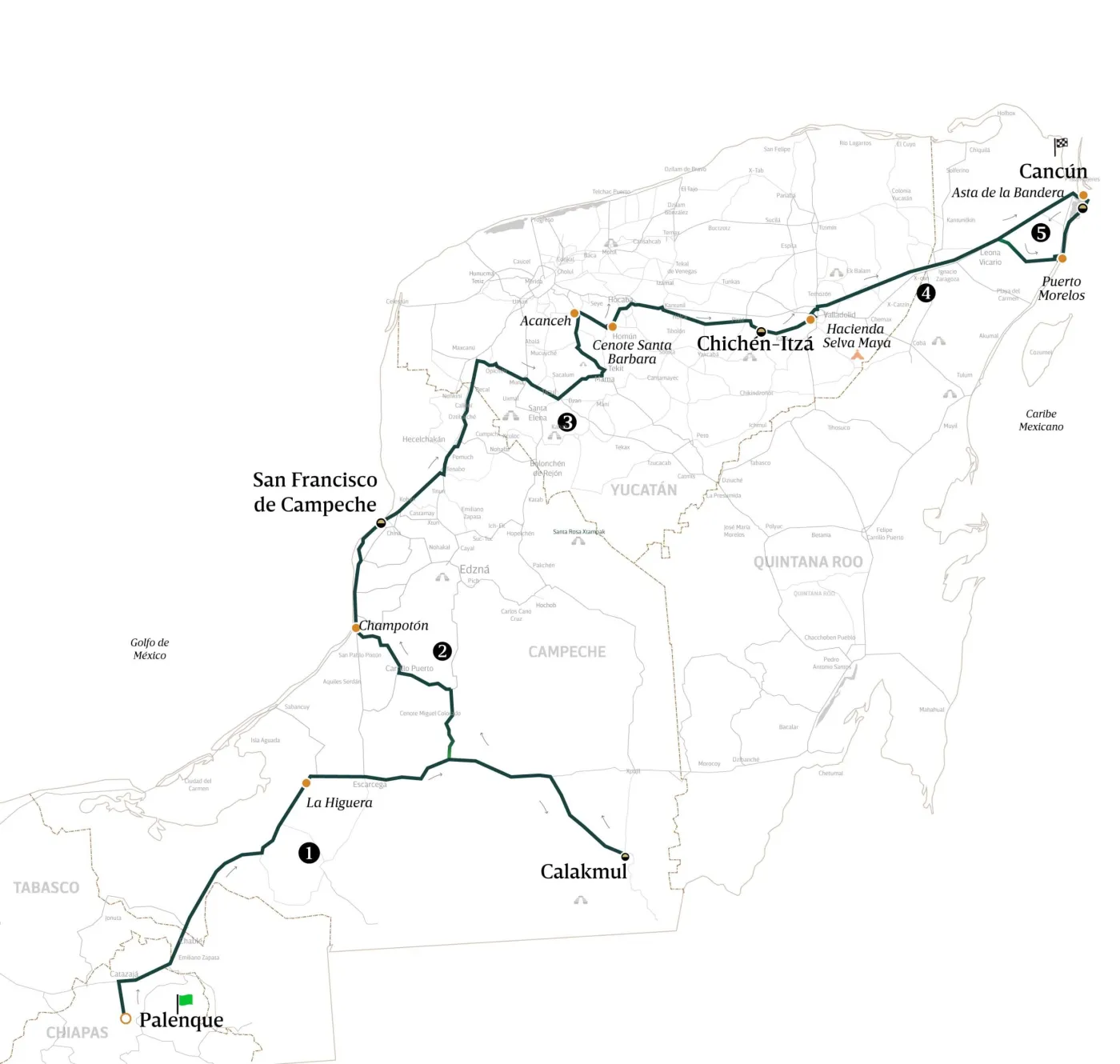
Stage 5: Cancún circuit (107 km)
The urban finale of the journey.
The final stage is short in distance but not in meaning. The 107-kilometer Cancún circuit takes the crews through the outskirts of the city, with a visit to Puerto Morelos, before finishing in Cancún. Here the urban setting adds a different kind of challenge: shifting traffic, constant intersections and the pressure of knowing that every second counts before the closing ceremony.
The circuit serves as a symbolic close to the journey: a final run that demands precision amid the complexity of the city. Crossing the finish line in Puerto Morelos is not just completing one more leg; it means having lived through an entire competition that joined five territories into a single route.
The closing dinner, presented by Porsche, becomes the setting for celebrating the end of the competition. Competitors stop being rivals on the road and become part of a community that shares the same legacy: having taken on the full RMM 12 route.
In 2026, the challenge steps up.
Rally Maya México 12 is designed as a sequence of tests that, taken together, define the essence of regularity competition. Each stage has its own character: endurance, skill, consistency, mental discipline and urban precision.
This is not a sightseeing tour or a casual itinerary: it is a competition that turns roads into exams, kilometers into achievements and finish lines into symbols of mastery.
RMM 12 is discipline, endurance and culture in motion. And the 2026 route is ready to be driven.